
This is an instalment of our series on Participative Prosperity

By Nina Newhouse, Senior Consultant
Delivering growth in every postcode
The English story shows us time and time again that growth can happen without making the people who live in an area more prosperous. The government's “growth in every postcode” ambition takes the right approach in that it refuses to write places off. But the risk is that it focuses on generating growth for growth’s sake, rather than building a new model for growth that allows more people, businesses, and communities to participate from the outset and experience the reward. At ICC, we’re calling this model “participative prosperity”.
Much of our recent work has focused on how this might be embedded through England’s Mayoral Strategic Authorities (MSAs). Representing the most significant reshaping of sub-national governance in a generation, since the arrival of Andy Burnham as Prime Minister earlier this year MSAs have been increasingly positioned at the centre of the government’s mission to drive growth in every postcode. The recent autumn budget provided helpful additional steer on what the path to more powers and more funding looks like for MSAs in the long term. In the context of rewiring the state, we saw the budget as more than just a fiscal event (“what money and powers are we getting”) - it was one of the strongest signals yet that in the eyes of this government, devolution and MSAs will drive the growth agenda.
Our work at Inner Circle is generating some helpful patterns in exactly how that happens. What's clear is that more powers and funding, while a brilliant and long-overdue development, aren’t the full story. We need to focus on some harder questions, like: what does it take to turn these powers and funding into real change people can see and feel? What kind of institution does each region actually need? And what’s needed to deliver on that in practice?
Different places need different growth pathways
There’s no single pathway to deliver growth. Some places already have strong skills, productive businesses and investment demand, but need to remove constraints around housing, land or connectivity. Others need to build more fundamental economic capacity before those opportunities can be realised.
Our bespoke Growth Pathway Model gives us an evidence-based way of understanding the different economic conditions across a region. It looks across three parts of a local economy: its engines of growth, including skills and productivity; its boosters, including business density and connectivity; and the factors that can enable or constrain growth, including housing, land and planning.
Applied across an MSA area, it can reveal where different places need to unlock, scale, strengthen or build parts of their economy. This gives MSAs a clear and entirely place-specific view of the different opportunities and constraints within their region, how its local economies fit together, and where regional action can have the greatest effect.
Economic diagnosis alone won't deliver change. MSAs also need the institutional capability to translate the evidence into choices, align partners and adapt their approach over time. We see five conditions as particularly important.
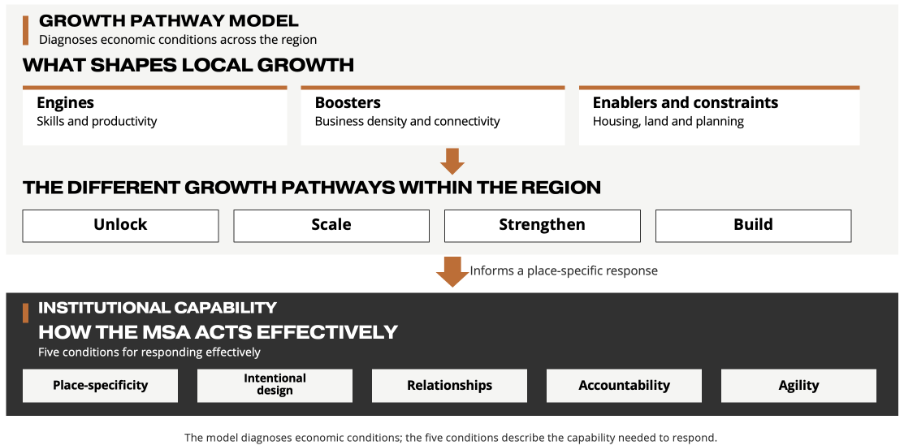
Figure: Understanding and Enabling Regional Growth through our Growth Pathway Model
Five conditions for growth
In our experience, places rarely fail for lack of ambition, assets, or talent. Delivering shared growth that people can see and participate in depends on designing the organisation around the following conditions.
1. Place-specificity.
The current pressure to “supercharge devolution” is a risk as much as an opportunity. The worst-case scenario is a set of boilerplate MSA operating models based only on the core competency areas as set out in the White Paper - designing change around a national template for safe and legal, rather than the outcomes that regions and residents so desperately need.
For devolution to work, all MSA activity must be rigorously grounded in what is true of place: what is the distinctive economic character of your region? What are the structural challenges that only a body at this geographic scale can address? Where does the combination of powers you hold, and the relationships you can mobilise, create a genuinely differentiated offer to investors, employers, and residents?
This also means understanding who currently participates in growth, who is locked out, and the systemic barriers behind that pattern. MSAs can use their knowledge of place, partnerships and market-shaping role to widen participation deliberately, rather than assuming that the benefits of growth will spread automatically. The MSAs that will use new funding and powers most effectively are those that can answer these questions clearly and early. That clarity then becomes the organising principle for delivery.
2. Intentionality in design. Delivering shared growth depends on connecting opportunity and people, assets and enterprise, strategy and delivery. Housing, health, transport and skills all belong inside the economic argument because they determine whether growth potential becomes participation.
The key is being clear against each what role the MSA can play, and what role it can’t. MSAs don’t “own everything” - they are strategic institutions whose power often lies not in direct delivery but in the ability to convene and influence. New powers and funding don’t change this but call for intentional understanding of the right role and designing around it. This looks different from place to place - what works for Greater Manchester (a large, mature institution with deep sector expertise and long-established partnerships) won’t work for a newly formed MSA in a very different regional economy.
3. Early, sustained investment in relationships. The real power of an MSA lies in system shaping: the ability to align the actions of multiple organisations around shared regional priorities. This does not materialise quickly or automatically. The authorities that are genuinely shaping their regional systems are those that have built this capability through sustained intentional engagement over time.
4. Accountability from the outset. The governance complexity of an MSA - constituent councils, mayoral office, combined authority board, multiple government funders, external delivery partners - creates a risk of accountability diffusion. Someone must hold the diagnosis, convene the partners, expose the trade-offs and be answerable for whether the system is changing.
5. Agility. There is no ideal-type operating model. Whatever you design will have to flex as local reality changes, and so will the organisation and its people. Design for adaptation and review as you go. That includes creating space for social innovation, rather than treating innovation as the preserve of the private sector. MSAs can crowd in new ideas and partnerships around place outcomes, while also innovating in how they operate in response to constant change.
Why this matters now
Together these conditions could separate a place that simply holds new powers and funding to one that uses them to generate change. Our view is that the authorities that take the time to ground their approach in place, intentional understanding of their role, system relationships and accountability, will be those that succeed: driving growth in every postcode that means something to the people that live there.